Showing posts with label guiding at vindolanda. Show all posts

Friday, 18 March 2011

felix dies nasi ruberis! Happy Red Nose Day!


Funny that! Nose can be feminine or masculine in Latin depending on which noun you choose:
naris-is (f)
nasus-i (m)
If anyone can tell me why this is so...I'd be very please to find out! Anyway

"Happy Red Nose Day!" felix dies nasi ruberis!

( Above: Scenes from the Minimus Mouse Latin Book)


Loads to tell you and little time to relate...so I will do it bullet point style:
1. Went on a research trip last weekend which included visits to Weald and Downland Open Air Museum, Sussex; Fishbourne Palace, Minimus Mouse Teacher Training Day (Salisbury), Salisbury Museum - Romans v. Saxons Exhibition - all wonderful!
2. Started teaching Minimus Mouse Latin in two of the three primary schools locally. Three boys wanted to be called iacobus (irrespective of their original names). Their combined enthusiasm is fantastic. At the first school (down the road - literally from Vindolanda) all of them had stories of Hadrian's Wall and how they felt about it. Lots of stories of finding Roman artefacts. Super! Eleven children in that first class (only about 30 in the school total) and 12 children in the second school (2 were missing so in total 14) out of a possible 30. So that is great for a lunchtime club when a lot of them could be outside playing...
I'll start in the third school (the closest to here) when their building work calms down a bit. Very soon. Fingers crossed. Got good numbers there too.
3. Moving out of the B&B so we can redecorate. (Back to little house in Haltwhistle.) American guests in next weekend and I'll be doing a tour of Vindolanda for them...their boy studies Minimus too...
4. A week of digging at Vindolanda starts April 4th. It's their first week back too on the archaeology front...and I'll be joining them. Can't wait!!!!
5. We, the volunteer guides, start guiding at Vindolanda around that time too...
6. Applying for quite a few grants to get my Hands-on-Latin business up and running from the B&B and potentially from Vindolanda too...fingers crossed again. (They have a new educational building there.)
7. Hmm...gosh...we have lots of other ideas too. But no time to tell of them here....
8. Yes - still writing the B&B website (the War and Peace version). I also have to do other stuff in/around setting up the business....so if I go quiet...you know (sort of) what I am up to.
9. Ah yes! Also doing an adult teacher training City and Guilds course in April/May.
10. Attending "Know your Hadrian's Wall" educational days whenever possible....
11. A blogger friend (who I have met through this blog and her blog) is going to help me run the Minimus teaching at the local schools. euge! Hurrah! She loves her Latin too.
12. Teaching some Minimus Latin and history to some adult friends of mine. Their feedback has encouraged me a great deal and reminded me that this course is appealing to adults too. Barbara Bell, Minimus creator, has said this and I truly believe her. I love the cartoons and its accessibility. euge for Minimus!

That's about it! Vale for now! Hadriana :)

Wednesday, 9 March 2011

Veni, vidi, visi! I came, I saw, I visited!

(short Eagle Eye 3D trailer)

(ten minute clip of the making of Eagle Eye 3D film)

I was over at Vindolanda today for my volunteer guide training day. We guides are now part of The Vindolanda Trust. We'll be guiding at weekends (twice a day at 10.45am and 2pm) from April until September. I wasn't sure what I was expecting of the newly renovated museums but I am more than suitably impressed! I am amazed by what they have created in these severe winter months....it is truly superb...

At Vindolanda, amongst other things, there is a special room to view, hear and read six of the famous writing tablets which have been returned to the museum from The British Museum. All the tablets have to be kept at a special controlled ambient temperature. The newly found Jupiter Dolichenus altars found in a very unusual temple within the fort are now on display. (Temples are never usually found in forts.)

The main museum (also known as Chesterholm) looks terrific. I'm still trying to take it all in. The items are all displayed to great effect. It is the finest Roman Collection in Britain. It is a research collection and all the items there are from Vindolanda (nowhere else). They are still putting the final touches to it so I'm dying to go back to see it all when it is finished.

The other museum, The Roman Army Museum, which stands on the hill overlooking our guest house here is absolutely, absolutely brilliant. It has been utterly transformed. I have to go back to look at it all again properly. There are fantastic displays where uniforms can be touched, you can try out being a Hamian archer...learn all about how a soldier existed as part of a contubernium (8 man tent), learn all about the entire Roman army formation within two minutes...see how the Roman Empire expands in front of your eyes...the building of Hadrian's Wall is displayed on a huge wall akin to Trajan's column...then  there is the marvellous 3D Eagle Eye film...which has good dollops of Latin thrown in for good measure e.g.:

Procedite! Proceed! Go forward!

Testudimen facite! Make a tortoise! (A Special Roman Army unit formation)

and much, much more...........

I urge you all to go and visit the museums this Saturday and onwards. They really are well, well, well worth a visit! I honestly haven't done justice to them here.

P.S.: Look out for a mention of it on Look North BBC1 this Friday Evening. The National Geographic Channel have also filmed a programme on the Vindolanda skeleton scheduled to be shown this September 2011.

Wednesday, 12 January 2011

Minimus Mouse Courses on Hadrian's Wall


My Big Plan for 2011 is to start to offer Minimus Mouse Courses on Hadrian's Wall - both at local schools and from our B&B. (Yes...I know our website is not finished yet...but completing it is part of the big plan!)

I'm a qualified Minimus Mouse Teacher (my blog post about going to Dulwich in 2008 to meet with Barbara Bell, the Minimus' author, and her colleagues is here). I'm starting to go to local primary schools to introduce the children to Minimus mouse.

It's a passion of mine and I wholeheartedly believe in the courses - Minimus and Minimus Secundus.

For those of you perpetually scarred by your schoolboy and schoolgirl Latin lessons please take note...this course is all about FUN!!!!! Here are a few facts about the course:

• Comic Strip Cartoon and Stories of Latin Mouse and Family. The story is based on a real Roman family who lived at Vindolanda, a Roman Fort in the area near Hadrian’s Wall, at the beginning of second century AD.

• Main Characters are: Flavius Cerialis (Dad and Fort Commander), Lepidina (Mum), Flavia (aged 16), Iulius (aged 13), Rufus (aged 3), Minimus (Mini Mouse) the mouse and Vibrissa (Whiskers) the cat. Also featuring Corinthus, Candidus and Pandora.

• The story is based on real archaeological finds found at Vindolanda (where archaeologists have been digging since the 1930’s and full time from 1970’s onwards).

• The Vindolanda Writing Tablets are Britain’s Top Treasure as voted by experts at the British Museum, have been found at Vindolanda - 1973 and onwards. The course draws upon the history and stories yielded by the writing tablets.

• Subjects covered include: the famous Birthday Party Writing Tablet, archaeological finds, music, design, drawing, geography, history, drama and acting, recipes, travel, roads, maps, Hadrian’s Wall information re – Vindolanda and other historical sites, Roman York, Greek myths, English poetry, chemical symbols, medicine, games, writing, jewellery making, weaving, shopping, learning about British tribes, the Roman army, bath times, Greek and Roman gods (to name but a few things!).

• Interactive learning: pronunciation of Latin words, Latin derivatives forming English words, syllabus supports learning of modern European languages and Key Stage 2 History (for children) and general background history for adults, helps with English vocabulary and grammar. Helps to refresh the Latin of children and adults who have already studied Latin.

• Guided visits by me (Hadriana) to the site and the museum to see where the family actually lived; what they did and what they used. (Vindolanda's Chesterholm Museum and The Roman Army Museum will be re-opened to great fanfare after their complete renovation this March 2011.)

• Written by Barbara Bell, MBE, and illustrated by Helen Forte

• Over 100,000 books sold: at least 10% of British Primary Schools are using this course.

• Internationally popular: Minimus is taught in Europe, USA, Australia, Canada and New Zealand

• Two stage course (Minimus and Minimus Secundus) with full colour cartoon stories, grammar and Greek myths published by Cambridge University Press Student books, teacher resource books, CDs and audiocassettes, DVD of Minimus the musical, further mini books as extension readers. Interactive website: http://www.minimus.com/

• Accessible to learners of all ages and abilities:

• “Minimus has introduced thousands of children to one of the great treasures of the British Museum. The delicate Vindolanda letters paint a vivid picture of everyday life in Roman Britain describing everything from birthday parties to knitted socks. Minimus takes this enthralling material and uses it well, bringing Latin and Roman Britain to life for its readers.” Neil McGregor, Director of the British Museum

• “Minimus flies off the Vindolanda Museum bookshelves as devotees indulge in the joyous adventures of this endearing Latin mouse. This is a wonderful way to introduce the Latin language to young people and it remains a firm favourite with children and parents alike.” Patricia Birley, MBE, Director of the Vindolanda Trust

• “When you finish the lesson Minimus makes you want to stay there forever.” Enthralled Minimus pupil


It's designed for 7-13 year olds but I know that people of all ages will get a lot of enjoyment out of studying it. (I'm teaching it to some adults as well who agree with me!) I'm also combining it with my guiding at Vindolanda (the fort) and The Roman Army Museum both of which are just down the road from here.

Ta da! That's what I am up to. Will keep you posted as I go along.....I'll also explain a few Latin bits and bobs as I go along too....

vale! valete! - Goodbye! (singular and plural forms of goodbye!) for now........Hadriana  :)

Thursday, 7 October 2010

Enjoying the Fall (and every minute of it)...

Decapitated milestone on Stanegate - on the way into Vindolanda
OK I admit it! my computer and Blogger have got me flummoxed. Everything seems to be working OK this morning including me.

I'm full of the joys of Autumn. It's beautiful outside. The sun is shining and the colours of the trees, bushes, leaves, fields, grasses are many hued, shiny, translucent.


What have I been up to? Well I've managed to load the photos of Vindolanda which I took a week ago. I've just got to see whether this format will now cope with my words. (I've worked it out. Please scroll past the photos down to the bottom.)

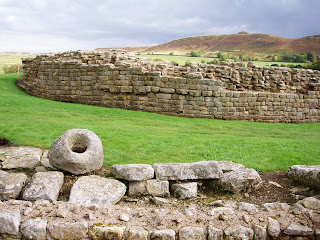
Parts of the water wells and Hadrian's Wall Reconstruction in the background

AD213 Military Bath house (later one) at Vindolanda. The original water proof, opus signinum (pink floor), can be seen in the foreground (half way up..it is horse shoe shaped)

Corner of Stone Fort II with Barcombe Hill in background

Stone Fort II with later bath house in background


"Y" shaped drain to catch the blood in the Butcher's Shop in the Vicus/Village
Roman Knife/Sword "grooves" at water well at West Gate

View of Vindolanda and brooding Barcombe Hill


The mysterious round house foundations beside fort walls and found in different places across the site

Would love to know what these markings are on the Via Principalis (in the fort)...will try to find out!

Marvellous masonry at HQ (Principia) Stone Fort II

View of CO's house (Praetorium - Stone Fort II) at Vindolanda

Looking back to West Gate via the fort drains!

Children and friends' children at Vindolanda

And again!

View of our wonderful tree outside my window

(Fellow guide, Patricia, and myself at the Mithraeum further down Hadrian's Wall last Saturday. A few of us were on an outing with the Friends of Segedunum (Wallsend). The Tour along the Wall, was led by the extremely knowledgeable Bill Griffiths, archaeologist, ex-curator of Segedunum. He is now North East Regional Museums Hub Manager of Tyne & Wear Museums. We followed the line of the Wall from Wallsend all the way out to Bowness on Solway. The whole Wall and frontier zone is still one huge jigsaw puzzle to understand but I saw bits of Wall I'd not seen before...including some in a carpark just before the junction of the A1 and A69 and at Heddon-on-the-Wall. The journey was a riot: full of good humour and lots of jokes. It really took me back to my roots. "A champion, canny day" was had by all.)

........Well...I've finished my side of the accounts/book keeping. Yeah! Will try to keep you posted on that score. The main thing is that we've had a storming season (despite not having finished the website) and we are still busy now...

And I've, more or less, finished my guiding for this season. We do a little bit more at October Half Term at Vindolanda and The Roman Army Museum which should be great. The Vindolanda Trust are getting ready to close the two museums at the end of October for complete refurbishment. The Vindolanda site (fort) will still be open until the end of January 2011. Both museums will open up again, ready for the next season, bright, shiny and spanking new.

So how did the guiding go?

I'm very pleased to say that, by the end of my first proper year of guiding, it went very well. Possibly very, very well! That sounds as if I'm not being very modest.* The truth is...that I was a bit wobbly at the beginning. Even I felt it. I was not even very happy with my introduction to the site. The way we'd been taught to start off...was at the water wells. In fact Vindolanda is a very complicated site (which I rather like as it is a challenge). I'm not over exaggerating..there is a lot of history there. No wonder the Vindolanda Trust say that there is another 150 years plus still to excavate. The Reverend Anthony Hedley started it all off in 1831 or thereabouts!

I'm also not criticising the way in which we were taught. Our teachers were/are two excellent Blue Badge Guides - Tom Keating and Jan Williams - they threw themselves into our training course and they worked so hard. They so desperately wanted us to do well. And we did.

I've stayed in contact with Jan and when I have my occasional wobble she's always been there for me - giving me some brilliant advice. Ultimately though, I've learned the old fashioned way, I have to make my tour my own.

I used to do the tour starting at the water wells and everyone seemed happy with the way I was doing it. But I wasn't. There were still some areas which I knew I had to brush up on. Again, I was busy during the Summer, with the children being off school, so did not really have a lot of time to do some reading...not the type of reading I wanted to do anyway.

When the school holidays came to an end we also started to see a different type of visitor at Vindolanda...the baby boomers. They certainly know their history. One tough, friendly group made me realise that I had to do some more reading and fast! (I don't mind. Anything, anybody...who keeps me on my toes...is good. We all get lackadaisical.)

I started to consult my own library of Roman books (which are starting to build up) and a super website/forum www.wedigvindolanda.com which has been created by a long standing volunteer excavator called Harry who is based in America. So effectively I started doing some digging of my own!

I came to the conclusion that I was happiest starting my tour off - over by the Stanegate - a road with a medieval name which was created by the Romans across this short isthmus from the Solway to the Tyne. Archaeologists are still debating when exactly it was created. I still need to do some more reading about it but I'm fairly sure that it had to be (t)here when the Romans decided to build their earliest camps and forts all along this region. It makes sense.

Despite it being a multi-layered site (there were, at least, six timber forts and three stone forts built at Vindolanda) I try to keep it simple for visitors whilst describing (succinctly) the span of the nigh on four hundred years of the Roman occupation. Along the lines of: How they started...what happened when Hadrian's Wall was being built...how they got going...what life was like at the peak of Roman rule...what life was like when The Roman Empire was on the wane...what happened when Roman life (perhaps) melted away....what happened when the Reivers took over.....then the crofters....then the antiquarians...then the Birleys...then The Vindolanda Trust...to the present day. All in 45 minutes to one hour.

And it is SO enjoyable. I LOVE showing people around. I adore talking to everyone...understanding why they are there and what they are interested in. Listening to their questions and attempting to answer them to the best of my abilities. If I can't answer them then I try to find the answer for them. The scenery is fabulous come sun, rain or shine. In fact I haven't done one tour where it has been raining (except for a tiny bit of drizzle perchance). My trusty yellow "Tour de France" umbrella has seen off those pesky droplets.

So, by complete accident, I feel that I have finally found my vocation - for me, myself, I, Hadriana: windswept, cloud and sun romanced, my ears trained for the call of a curlew...it's a far cry from those City days, in pinstripe suits, staying in five star hotels all over Europe...feeling isolated, bored, frazzled, in those elegant rooms with room service on tap.

[Fingers crossed that our guiding programme can continue into 2011. The funding for it comes to an end of December 2010. We have been well received. Let's hope that good reception can be sustained into next year!]

* On my last tour of the season one of our B&B guests, who is a writing a doctorate on the Thracians, who came on my tour, said it was one of the best he'd ever been on! (What does Alan Partridge say?...."Back of the net?!" I hadn't even paid him lots of denarii to say that either!)

Ooh. By the way. I'll be starting a new blog shortly (as well as this one) which will be a lot more general and covering lots of different subjects to show that I have other interests beyond the Romans!!! (I still plan to continue this one as well.)

As always, many thanks for reading! Valete!

Hadriana xx 

P.S. The Tullie House Museum is trying to save the rare Roman Helmet and Face-Mask, found in the Lake District, for this region. It is being auctioned by Christies today. Read about it here.

Tuesday, 28 September 2010

Holding hands with the present, the past and the future


I think I need to sort out my computer as I seem to have lost the ability to download photos (and add links). So please imagine an image of a small hand holding a big hand.


I'm fairly convinced that I've lost a handful of followers after the Vindolanda post (recent one) about the discovery of a child's skeleton there. I can understand why (at least I think I can) although it still hurts to lose followers.


I'll try to explain why there's a mixed message in there.


I would never hurt a child or a person...in thought, word or deed but I know that I'm no angel. (Although I would like to be one and try to be an angel every day. I love getting on with everyone but I'm human...I do have bad moods. I do lose my temper. I'm not the most patient person in the world although I try to be and so on. I would not lay a finger on anyone...in fact I'm harder on myself than anyone else. Especially when I mess up!)


I've always wanted to write...ever since I was very little. I've also been very interested in the crime genre - Raymond Chandler, Ed McBain, Dashiell Hammett and so on. Paradoxically since I've had children I now can't cope with any visual violence and much less..with the current fashion for showing very graphic violence to women, men and children on screen. I run away from that stuff and hide behind the sofa. Give me "Downton Abbey" every time. That's why I like "Morse" because it is a cerebral "cop" show. I don't really see anything in it which makes me head for the hills. Perfect. I get a good night's sleep.


I do try to imagine the dark side of life. Why? Because it's there and I can't get away from it. In fact some fairly awful things happened to my close family (in the last war) and to a former boss. (I can't quite bring myself to discuss these in public just yet.) So my active imagination runs away with things at times. I've learned that there's no point in hiding these things under the carpet. They have to be brought out and examined in broad daylight from time to time. In fact, to be an effective guide or storyteller, I have to think about them. Whether I like it or not.


I'm also sleeping more easily these days as little boy sleeps in the same bed with me (which he has done for years now)...holding my hand. I love the feeling of his little hand in mine when he falls asleep at night. It is a feeling that I will cherish for the rest of my life.


Little girl is more feisty and independent but even she has an amazing imagination. She is very artistic and is constantly drawing pictures. She is an amazing storyteller. She's also soft at heart and loves her hugs.


We've had a bit of a battle recently as she won't go to sleep. She's afraid of the dark. She's afraid of the house burning down. So much so...I got the fire brigade in to fit extra fire alarms. To little effect. She's moved into our room too. Everyone goes to bed at 8pm now and we all sleep soundly. If I'm lucky I can get them to sleep and creep downstairs to watch a bit of telly. The stuff that doesn't frighten me that is!


I'd still like to write. If I ever get the time to do it. If I do...I'll be intrigued to see whether it features the dark and bleak stuff or not....


By the way I'm still dealing with our accounts and coming to the end of the guiding season at Vindolanda. So it's.........


Bye for now! Hadriana xx


PS: My next post will be on "end of the guiding season".
Sorry that I'm a bit rubbish at getting back to your comments. I will try really hard to do that from now on - now that the main busy B&B season is coming to an end.... :)


Wednesday, 15 September 2010

Grisly Vindolanda Discovery

VINDOLANDA PRESS RELEASE: 14/09/10


SKELETON OF A YOUNG PERSON FOUND BURIED IN ROMAN BARRACKS AT VINDOLANDA


Vindolanda archaeologists are well used to finding thousands of the Roman army’s old weapons, armour, coins and household effects, but they received a nasty shock last week when a volunteer found an almost complete human skeleton buried in a pit in a barrack room floor. Human burials in built-up areas like forts and towns was strictly forbidden in Roman times – the dead had to be interred or cremated in cemeteries on the outskirts – so the archaeologists at first assumed before the complete skeleton was uncovered that the remains must be those of a large dog. But when the complete skeleton was examined by an anthropologist, Dr Trudy Buck, of Durham University, she quickly realised that the bones were those of a young person, possibly a girl, aged between 8 and 10 years old.


The pit in the barracks dated to the mid third century AD, when the Fourth Cohort of Gauls formed the garrison, and the concealment of the body in this fashion was a criminal act – and it is hoped that further study of the remains may reveal the cause of death.


Dr Andrew Birley, Vindolanda’s Director of Excavations commented: “In the 1930’s my grandfather, Eric Birley, found two skeletons concealed below a floor in a civilian building at Housesteads, one of whom had the blade of a knife stuck in the ribs, and the later coroner’s inquest duly produced a verdict of murder by person or persons unknown, shortly before AD367. I’m sorry to say that Vindolanda has probably produced another Roman murder victim, from around the AD 250’s and I shudder to think how this young person met their fate”.


When the forensic examination has been completed at Durham University, the skeleton will be returned to the Vindolanda Museum and will then come under the care and protection of museum curatorial staff. Visitors to the museum will be able to see the mortal remains of the unknown youth, whose fate has only been discovered nearly 1800 years after their death, and the results of the forensic examination next spring.


Patricia Birley: Director, Vindolanda Trust
VINDOLANDA PRESS RELEASE ENDS
 
******************************************************************************
Since the skeleton was identified as being that of a human - everyone who works at Vindolanda was sworn to secrecy about it. And rightly so.
 
I got to hear about it just under a week ago. For the last two weeks I have either been guiding there or showing friends around. Until the end of yesterday (as well) I had also been staying at my parents' house looking after my 94.5 years young grandfather. The parental dwelling is a converted Methodist chapel and the small boiler house, at one side of it, contains stones pilfered from Vindolanda hundreds of years ago. I'm convinced that a certain stone, they have, is of Roman origin as well.
 
As such, last week I got swept up and into Vindolanda skeleton cabin fever.
 
Everyone is taken aback at the grisly find. It was completely unexpected and it was found in a very unusual place that's why it was mistaken for being a large dog at first. The Romans cremated their dead. It was later under Hadrian that they began to bury their dead along roads away from towns. Sometimes they would be buried with grave goods. Tony Wilmott, the English Heritage Archaeologist, is leading a very interesting project looking at a Roman cemetery up at Birdoswald Fort.
 
When I heard about the discovery of this skeleton I was shocked myself. I'm still learning a lot about archaeology - absorbing what goes on and how it becomes a science. As far as I know everything is recorded in minute detail...the exact location of the find, what it is, how it can be accurately dated (or not), where it came from, who owned it, who made it, who transported it, how it was transported, et cetera. Every find is given a number, indexed...then the long and costly process of preservation begins. A report has to be written on every find and if we, the public, are lucky - the find then goes on display. Even the display of the object can be a tricky and time consuming process. The cabinets, which are to hold the delicate and fragile Vindolanda writing tablets, are said to cost half a million pounds each.
 
So there you have a very broad brush explanation of the archaeological process - as I say...I am by no means an expert. I'm trying hard to soak up information about it. I find it fascinating and would like to do some digging at Vindolanda next season if I am lucky. Vindolanda takes on volunteers from all around the world so sometimes it can be a fight for places! My fingers are crossed.
 
I'm one of many who have been watching the delightful Alice Roberts take us through the different ages of archaeology in the recent "Digging for Britain" series. The shocking discovery of this child at Vindolanda (my own daughter is nearing the age of the child who may have been murdered by person or persons unknown in the mid third century) has made me think long and hard about it all.
 
We can all get a bit laidback about it: "Oh here is another leather shoe!" or "Here is a bit of Samian ware!" but when the remains of a human being are found in a place where they are not expected to be found...then the reality hits home. I find it difficult to write, think or put some sensible words together regarding what was a brief, horrifyingly expunged human life. It is just truly shocking and incredibly sad that someone so young should have their life ended in dire circumstances.
 
As I write violent images are conjured up in my head. My first instinct is to go back in time and save that young child's life - ensuring that I take them away from harm. I am incredibly soft at heart and detest any conflict whatsoever. I cry over anything that is remotely emotional. I detest moods or anything that smacks of "the black dog" being in the air. If I sense it, like a hunting dog, I will try to steer other people away from it....whether it is inside me or in others.
 
As much as I am in thrall to the Roman way of life I realise that there is a side to them that cannot be softened no matter what: Gladatorial combat to the death for public amusement, slavery, war, the imperial army as a fighting force...the list continues. Nevertheless I think we are mesmerised by them because they reflect our way of life far more than the Anglo Saxons, Normans or even the Tudors ever will do. (The Victorians begin to sidle up to us some more - running parallel lives to us.)
 
But I want to point out that there is an unmistakeable, unstable side in all of us, even me...as soft as I am. The wrong thought, word or deed can pop out when least expected (but I have to emphasize that I do not condone physical or mental violence of any sort!)...

I wonder whether this child ended up being in the "wrong place at the wrong time" receiving a strong cuff, causing him/her to fall over and strike their head and die. (It could have been much worse than this.) Panic ensues: "Quick!" "Cover up the body before anyone sees!" Maybe the body is then placed somewhere where it cannot be found before the cry goes up from the fort village (vicus) that a child is missing. The guilty party or parties feel that they have to take part in those search parties to look for the missing child...going out into the daylight or dark with a hard knot in their stomach(s)...delving into nearby streams or woods............knowing that this time that sickening feeling will be with them for the rest of their lives...and can never be so easily blotted out. Not even with a sacrifice to the gods...
 
(I want to emphasize over and over again. . . that I do not condone violence to anyone - whether they be a child or adult of any sort. Nevertheless the world is an ambiguous place...look at our fascination with crime and murder books. In my ideal world I would not have a bad thing said about anyone to anybody nor anything bad happen to anyone! I'm also a realist and know that bad stuff happens. Very, very sadly.)

And I feel for Dr. Andrew Birley...the Director of Excavations, under whose watch the skeleton was found...he too has two young children. He too must have that awful churning feeling - thinking about the fate of that vulnerable child. Nevertheless I am a great believer in fate and, perhaps, in this uncovering of the unknown child, in this second millennium, its spirit can, finally, be put to rest. . .

Wednesday, 11 August 2010

The Concrete Power of Roman Aqueducts


Quite a few people on my tours at Vindolanda ask me about Roman concrete. I've tried to find out about it as best I could. (Click on the "concrete link" for more information.) The video clip above describes the process briefly.

I got into discussion with one chap, a civil engineer, the other day, who has worked on a variety of civil engineering projects past and present. He is currently working on a project - something to do with the spire at Westminster Abbey. We had a chat about Roman methods of making concrete. I naturally talk about "opus signinum" which is a special waterproof concrete (broken up tiles mixed with lime mortar) which are still in evidence in the floors of the bathhouses. There is also the traditional Roman lime mortar concrete (the Romans were the first to invent concrete...which aided their imperial expansion plans massively). This film here shows that even their normal concrete, itself, is waterproof and goes on to show how the Romans built aqueducts and how they could bring in loads of water - 300 gallons per head per day in ancient Rome which is more than five or six times what modern day cities manage. So "what have the Romans ever done for us?" They gave us: concrete!

There are two bathhouses at Vindolanda. I show the visitors the more modern one (built c. AD213 for the Fourth Cohort of Gauls) and it is very near Stone Fort II...quite near part of an exposed aqueduct. So far so easy as to how they got the water to it. The big conundrum (maybe) is the older bath house at the far end of the site built for double the number of men (1000) c.AD100. It is not near a visible water source. It was demolished by the Romans themselves a bit later on. It had become outmoded and was too big for later garrisons. How did they get their water there? Well, having looked at this film where it talks about transporting water from 40/50 miles away, via aqueducts, into the heart of Rome.....then a few extra yards at Vindolanda isn't going to make a lot of difference quite frankly. Case closed. In fairness the archaeologists did find long alder pipes in 2003, fitted with oak pegs, where the water was still running through them almost two thousand years later. Maybe the water got to the bath house via a mixture of pipes and aqueducts. It definitely got there somehow as 100 men got to be clean all in one go!

A couple of years ago I read Robert Harris's superb novel, Pompeii, and its link is here. The whole premise of the book is built around the magnificent engineering of Roman aqueducts. The link, I've highlighted, is well worth the read as it is designed for book clubs. So now when I think of aqueducts I think of his book and the breath taking aqueduct at Segovia, Northern Spain. I can't remember whether I got my photo snapped there. I'll have to rootle around my old photo books. (Strawberry Jam Ann has just reminded me of a marvellous, world famous restaurant there where I was lucky enough to dine once - el meson de candido...The roast suckling pig is famed across Spain!)

I'm away from my computer over the next few weeks for a variety of reasons. I'll continue posting but may not be able to get back to you/your comments for a wee while. Happy Summer Hols everyone!

P.S.: Looks like an interesting programme on archaeology will be shown over the next month or so. It's called "Digging for Britain" and starts 9pm on Thursday 19th August on BBC2. It is shown at 10pm the same day on BBC HD for those of you with programme clashes! (Must admit that the silly but fab "Mistresses" is on at 9pm. !!)

Friday, 9 July 2010

"It's a wrap!"

...are words that I never expected (ever in my life!) to be directed at me!

I'm very much aware that my blog has taken on narcissistic qualities of late. That's right...it's all about me, me me, me......BUT....I cannot help writing about my latest experience: my brush with fame and having a super, marvellous film crew from Endemol (that's right, French Fancy, the chappies who make "Big Brother", Mr.H. when he discovered this immediately started to take the michael out of me by putting on his best Geordie accent..."'Adriana's in the house et cetera!". I digress...)

Last week. The day before I was due to go to Arbeia (South Shields Roman Fort) to do my digging I got a 'phone call out of the blue from Kerry at Hadrian's Wall Heritage Ltd. asking me: Would I like to be part of some filming they were doing along the length of The Wall? Ever the one to jump into the deep end I instantly said "Yes!" despite having no knowledge of filming (or being filmed). Actually that's a slight lie as I did take part as an extra in a film being shot around the outskirts of Newcastle about a billion years ago. I can't even remember what the film was about but I just remember that the scene in which I was involved was about a party. A good friend of mine was going out with a sound engineer who worked on "The Tube" music programme that used to be filmed out of Newcastle...yes..that one with Jools Holland and Paula Yates...maybe it was something to do with that....hmm...

Anyway back to the here and now.

Michelle and Angela from Endemol came to see me when I was doing some digging at Arbeia and we had a brief chat in the snaking corridors of the Tyne and Wear Museum surrounded by towering cardboard boxes full of artefacts. They were getting to know me and I was getting to know them. The theme was to be that of Vindolanda as a secret garden. I was to reveal where the hidden, recondite, intimate and lesser known spots were in and around the fort.

A week later (this last Wednesday) the mini film crew arrived from Endemol: Gary, Alex and Liz. To say I was nervous about the whole thing was a vast understatement. I was petrified. I met them just as I had come back from walking our dog, Ed. They looked friendly enough. Not too threatening. Gulp!

I welcomed them into the B&B. Mr.H. soon provided us with tea, coffee and nice, juicy, thick, buttery toast. Alex (the dark haired one seen interviewing me in the photos) was the interviewer, Liz was the camera woman and Gary provided direction. In the photos above you can also see Michelle (she's wearing a grey jacket) who was running the whole thing. She popped in from time to time with her colleague, Angela. There were six groups of people in total being filmed doing different things in/around Hadrian's Wall Country.

The above photos show me being interviewed in Four Wynds' patio and garden: "What was my motivation for becoming a volunteer guide?" "How did we come to start the B&B?" and so on... From starting out on our sofa looking and feeling like a rabbit caught in the headlights my blood pressure slowly began to come down and my pulse moved from a gallop to a canter to a trot. Liz, Alex and Gary began to cast their magic. They also, later, filmed me pouring a cup of tea...so I had to master not pouring boiling hot water on my hand and to speak some sense at the same time....I just managed not to scald myself.

At lunch time we moved on to Greenhead (our nearest village). We interviewed a local long standing resident and Mr. Robert C. at his workshop, Rosemary and Katie at the wonderful Old Forge Tea Rooms who make divine teas and cakes, Dave over at The Greenhead Hotel (he and his wife run the pub, the B&B rooms and the Youth Hostel across the road). The sun was out in its full glory. Hurrah! We wandered into the churchyard to see the vicar but as he's retiring (bless him - he's lovely!) he was absent. He has a trillion leaving tea parties to attend this month.

We then went over to Vindolanda. I took them the long route round on the Military Road so that they could see Sycamore Gap (I think that was my plan...my head was in a whirl). We had lunch at Vindolanda's Lepidina Cafe in the baking sun. (It is a massive suntrap down in the valley by the Chineley Burn beside the Chesterholm Museum, the reconstructed Roman temple, shop, house, crofter's bothy and milestone. It was tempting to stay lounging there.)

We pressed on. We went to film up at the top of Barcombe Hill. I showed them the long stone set up to a quarryman who had lost his life, the Roman quarries with the good old phallic symbol carved into the rock face, and the sublime view of Vindolanda below us. (More Barcombe Hill photos to come in due course.)

Yesterday morning, with Gary, we filmed some bits at Vindolanda: outside before the museum opened...more intros (complete with an interested cow in the background), an interview with a lady getting off the AD122 bus, some segments in/around the fort (at the stone fort and at the timber gate posts of previous timber forts) plus the reconstructed bit of Hadrian's Wall within Vindolanda.

I could reveal more about these segments but I'm waiting to see what is in/what is out of the final edit. All the pieces from all the contributors will (hopefully) end up on Hadrian Wall Heritage's website. I await with bated (and unabated) breath. They say that looking at yourself on film is an excruciating process. Watch this space! (As they say....)

Nevertheless I am very pleased to say that I enjoyed every minute of it (despite all my expectations). So it's huge thank you from Hadriana to the guy and gals at Endemol who made the last couple of days so pleasurable. Thank you muchly! !  Gratias vobis ago!

Sunday, 27 June 2010

A Rollicking Roman Round-Up!


Guide to the Photos:1. My fellow volunteer, Michael, holding up the replica milestone (just kidding) at Vindolanda and myself (OK enough photos of moi...methinks...you know what I look like now...)
2. Another fellow volunteer, Lynn, snapping away at Vindolanda
3.Patricia Birley, Director of The Vindolanda Trust, Curator of the Chesterholm Museum, opening the Evening for the Friends of Vindolanda (June 26th pm)
4.Justin Blake, Deputy Director of Excavations, Vindolanda (June 26th pm)
5. Roman Soldier (June 26th pm)
6. Dr. Andrew Birley, Director of Excavations at Vindolanda (June 26th pm)

A lot of things have been happening lately and I've realised that if I don't write them down now then I'll forget what's going on...

At a recent meeting it was decided that the volunteers would start their tours around Vindolanda at 12.30pm until 1.30pm. We then zoom over to The Roman Army Museum to do our stint at 2pm until 3pm. The archaeologists also do a 2pm talk most days at Vindolanda as well...best to check the website and reception for further details. We may do extra tours as and when we can during mid/late September. (Our tours start around 16th/17th July and finish at the end of September. We do a further week - in the October half term week.)

The second annual Hadrian's Wall Archaeological Forum took place a week yesterday at Hexham's Queen's Hall and was well attended. All the speakers had us spellbound but the ones whose talks stood out (at least for me anyway) were: Justin Blake on his update of finds at(yes that place again) Vindolanda during 2009, Tony Wilmott, English Heritage, who talked about his discoveries at the Roman Cemetery at Birdoswald Fort and Richard Annis, Durham University, who talked about a bit of Hadrian's Wall which his team had unearthed in Melbourne St. Newcastle (now underneath a hotel but well preserved) and the BEMCO site in Newcastle where stone sarcophagi had been found (again by his team). Richard's memorable term was that of "body sludge" and which Latin term I discovered (by complete accident) is: adipocere. "When a body decomposes, it gradually turns into a waxy substance called adipocere." (From a recent quote/article in The Sunday Times featuring Alistair Pike, Head of Archaeology and Anthropology at Bristol University about the granddaughter of Alfred the Great.)[adipo = fat cera = wax]

We also had a returning guest stay with us especially for the Hexham Forum shindig and it was very nice to see him again.

This last extremely sunny week we've also had two Vindolanda diggers (plus another returning digger and his wife) staying with us. They had a whale of a time and really enjoyed themselves. They were working on Justin's section so we got a tiny update of what was taking place there prior to last night's annual Friends of Vindolanda Open Evening where the two archaeologists: Andrew Birley and Justin Blake explained (as they do each year) what they had uncovered in the year to date. Patricia Birley started the proceedings with an update on the exciting plans for Vindolanda and The Roman Army Museum. She announced that both sites will be closing on 1st November 2010 and would then be reopening in Spring/Easter 2011 in their new incarnations. A brand new 3D film of the Eagle's Eye is to be shown in The Roman Army Museum. Many attractions are planned for both sites including the coming home of some of the Writing Tablets from The British Museum to Vindolanda.

Very many of the Friends turned out for the talks. The weather stayed incredibly bonny and we all meandered down to the Museum at the end for wine and Roman culinary delights.

Before I forget this last thing...I'll mention it now...Channel Four are showing a documentary about the African Roman Emperor Septimius Severus entitled "The Untold Invasion of Britain" at 9pm this Thursday July 1st. In AD207 Severus decided to sort out the tribes and lands beyond Hadrian's Wall with disastrous consequences...

I'm also off to the Arbeia fort in my hometown of South Shields to do some digging on Wednesday. All supervised and above board of course!!!!

Vale for now! Hadriana :)

Saturday, 24 April 2010

Who'd 'a thought it?!


With the exception of my mum looking sultry and a certain visitor from Northern Italy looking a little bit glazed (bottom right hand corner) all the other photos are of me when I was a few years younger (just a tad)!

Who'd a thought that I'd end up guiding at Vindolanda?...a life spent going from Jarrow (where I was born)to South Shields, Ivrea (Northern Italy), Newcastle, Hampstead, Cordoba, Lisbon, Zaragoza, Newcastle, Nottingham, Kew, Richmond, The City, Canary Wharf, Hurghada (Egypt), Haltwhistle, Greenhead and then Vindolanda....obviously with a few more deviations via London and Newcastle thrown in...most notably Venezuela and Costa Rica.

I'm not really showing off because I don't think that my life is particularly extraordinary. As the volcano ash debacle has shown - we all seem to live far flung lives these days.

Anyway. I digress. Somewhat.

Yes...I DID IT!!!

After all the trials and tribulations of my "annus horribilis" last year...I finally did it.

I guided twice at Vindolanda and had three postings at the newly revamped The Roman Army Museum. (If you get a chance to go and look at the new gallery...it is well worth it. At the Roman Army I talk about artefacts - religious and household. Some are real and some are copies. The visitors come and talk to me after they've seen the Eagle Eye film. We have some great conversations.)

I was very nervous to say the least.

My first group numbered approx. 30 - a mixture of families - all ages and different nationalities. I was lucky with the weather both times. The only thing I forgot to mention on the first outing was the Roman "pub" or "thermopolium" but I did tell 'em about the water wells/Barcombe Hill, the stanegate (important stone supply road), the 4th century bath house, the Roman village with its high street and butcher's shop, where Hadrian's Wall was/is, where the Vindolanda Tablets were found, the reconstructions of Hadrian's Wall, the HQ of the stone fort, the posh house of the C.O. and the reconstructions of the Roman temple, shop, house, lapidarium (replica altar area) and crofters' bothy. Then the museum...and got them there so they could enjoy the sun and a well earned cuppa. All in 45 minutes.

The second group numbered six but it was no less an experience. It was fascinating (from my side) to have to vary my delivery in relation to the size of the grouping. Obviously the second outing was more personal. We had one Dutch guy with us and two from Wales so I tailored my information a little to highlight how many different nationalities were billeted along the Wall. The Dutch Batavians built the first bigger bath house at Vindolanda and the second legion from South Wales helped build the Wall. There was a welsh chieftain, Brigomaglos, who had a Christian burial at Vindolanda. His real tombstone is over at Chesters museum. (In fact a great swathe of native tribes probably spoke a form of Welsh when the Romans arrived. For instance Carlisle comes from "Caer" Celtic for castle or fort and was recorded as having the pre - Roman name: "The wall of the god Lugus" - "Luguvalos" which the Romans simply made it into "Luguvallum".)

So I'm chuffed to bits. I did it without losing my memory, falling over or generally making a twit of myself. My younger self would have been proud and amazed. Just like me, myself, I at 43 years. Euge! Hurrah!