 |
| Decapitated milestone on Stanegate - on the way into Vindolanda |
I'm full of the joys of Autumn. It's beautiful outside. The sun is shining and the colours of the trees, bushes, leaves, fields, grasses are many hued, shiny, translucent.
What have I been up to? Well I've managed to load the photos of Vindolanda which I took a week ago. I've just got to see whether this format will now cope with my words. (I've worked it out. Please scroll past the photos down to the bottom.)
 |
| Parts of the water wells and Hadrian's Wall Reconstruction in the background |
 |
| AD213 Military Bath house (later one) at Vindolanda. The original water proof, opus signinum (pink floor), can be seen in the foreground (half way up..it is horse shoe shaped) |
 |
| Corner of Stone Fort II with Barcombe Hill in background |
 |
| Stone Fort II with later bath house in background |

 |
| "Y" shaped drain to catch the blood in the Butcher's Shop in the Vicus/Village |
 |
| Roman Knife/Sword "grooves" at water well at West Gate |
 |
| View of Vindolanda and brooding Barcombe Hill |

 |
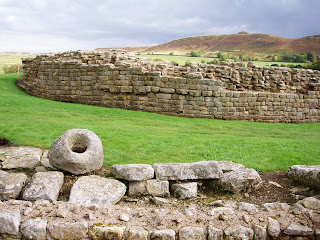
| The mysterious round house foundations beside fort walls and found in different places across the site |
 |
| Would love to know what these markings are on the Via Principalis (in the fort)...will try to find out! |
 |
| Marvellous masonry at HQ (Principia) Stone Fort II |
 |
| View of CO's house (Praetorium - Stone Fort II) at Vindolanda |
 |
| Looking back to West Gate via the fort drains! |
 |
| Children and friends' children at Vindolanda |
 |
| And again! |
 |
| View of our wonderful tree outside my window |

(Fellow guide, Patricia, and myself at the Mithraeum further down Hadrian's Wall last Saturday. A few of us were on an outing with the Friends of Segedunum (Wallsend). The Tour along the Wall, was led by the extremely knowledgeable Bill Griffiths, archaeologist, ex-curator of Segedunum. He is now North East Regional Museums Hub Manager of Tyne & Wear Museums. We followed the line of the Wall from Wallsend all the way out to Bowness on Solway. The whole Wall and frontier zone is still one huge jigsaw puzzle to understand but I saw bits of Wall I'd not seen before...including some in a carpark just before the junction of the A1 and A69 and at Heddon-on-the-Wall. The journey was a riot: full of good humour and lots of jokes. It really took me back to my roots. "A champion, canny day" was had by all.)
........Well...I've finished my side of the accounts/book keeping. Yeah! Will try to keep you posted on that score. The main thing is that we've had a storming season (despite not having finished the website) and we are still busy now...
And I've, more or less, finished my guiding for this season. We do a little bit more at October Half Term at Vindolanda and The Roman Army Museum which should be great. The Vindolanda Trust are getting ready to close the two museums at the end of October for complete refurbishment. The Vindolanda site (fort) will still be open until the end of January 2011. Both museums will open up again, ready for the next season, bright, shiny and spanking new.
So how did the guiding go?
I'm very pleased to say that, by the end of my first proper year of guiding, it went very well. Possibly very, very well! That sounds as if I'm not being very modest.* The truth is...that I was a bit wobbly at the beginning. Even I felt it. I was not even very happy with my introduction to the site. The way we'd been taught to start off...was at the water wells. In fact Vindolanda is a very complicated site (which I rather like as it is a challenge). I'm not over exaggerating..there is a lot of history there. No wonder the Vindolanda Trust say that there is another 150 years plus still to excavate. The Reverend Anthony Hedley started it all off in 1831 or thereabouts!
I'm also not criticising the way in which we were taught. Our teachers were/are two excellent Blue Badge Guides - Tom Keating and Jan Williams - they threw themselves into our training course and they worked so hard. They so desperately wanted us to do well. And we did.
I've stayed in contact with Jan and when I have my occasional wobble she's always been there for me - giving me some brilliant advice. Ultimately though, I've learned the old fashioned way, I have to make my tour my own.
I used to do the tour starting at the water wells and everyone seemed happy with the way I was doing it. But I wasn't. There were still some areas which I knew I had to brush up on. Again, I was busy during the Summer, with the children being off school, so did not really have a lot of time to do some reading...not the type of reading I wanted to do anyway.
When the school holidays came to an end we also started to see a different type of visitor at Vindolanda...the baby boomers. They certainly know their history. One tough, friendly group made me realise that I had to do some more reading and fast! (I don't mind. Anything, anybody...who keeps me on my toes...is good. We all get lackadaisical.)
I started to consult my own library of Roman books (which are starting to build up) and a super website/forum www.wedigvindolanda.com which has been created by a long standing volunteer excavator called Harry who is based in America. So effectively I started doing some digging of my own!
I came to the conclusion that I was happiest starting my tour off - over by the Stanegate - a road with a medieval name which was created by the Romans across this short isthmus from the Solway to the Tyne. Archaeologists are still debating when exactly it was created. I still need to do some more reading about it but I'm fairly sure that it had to be (t)here when the Romans decided to build their earliest camps and forts all along this region. It makes sense.
Despite it being a multi-layered site (there were, at least, six timber forts and three stone forts built at Vindolanda) I try to keep it simple for visitors whilst describing (succinctly) the span of the nigh on four hundred years of the Roman occupation. Along the lines of: How they started...what happened when Hadrian's Wall was being built...how they got going...what life was like at the peak of Roman rule...what life was like when The Roman Empire was on the wane...what happened when Roman life (perhaps) melted away....what happened when the Reivers took over.....then the crofters....then the antiquarians...then the Birleys...then The Vindolanda Trust...to the present day. All in 45 minutes to one hour.
And it is SO enjoyable. I LOVE showing people around. I adore talking to everyone...understanding why they are there and what they are interested in. Listening to their questions and attempting to answer them to the best of my abilities. If I can't answer them then I try to find the answer for them. The scenery is fabulous come sun, rain or shine. In fact I haven't done one tour where it has been raining (except for a tiny bit of drizzle perchance). My trusty yellow "Tour de France" umbrella has seen off those pesky droplets.
So, by complete accident, I feel that I have finally found my vocation - for me, myself, I, Hadriana: windswept, cloud and sun romanced, my ears trained for the call of a curlew...it's a far cry from those City days, in pinstripe suits, staying in five star hotels all over Europe...feeling isolated, bored, frazzled, in those elegant rooms with room service on tap.
[Fingers crossed that our guiding programme can continue into 2011. The funding for it comes to an end of December 2010. We have been well received. Let's hope that good reception can be sustained into next year!]
* On my last tour of the season one of our B&B guests, who is a writing a doctorate on the Thracians, who came on my tour, said it was one of the best he'd ever been on! (What does Alan Partridge say?...."Back of the net?!" I hadn't even paid him lots of denarii to say that either!)
Ooh. By the way. I'll be starting a new blog shortly (as well as this one) which will be a lot more general and covering lots of different subjects to show that I have other interests beyond the Romans!!! (I still plan to continue this one as well.)
As always, many thanks for reading! Valete!
Hadriana xx
P.S. The Tullie House Museum is trying to save the rare Roman Helmet and Face-Mask, found in the Lake District, for this region. It is being auctioned by Christies today. Read about it here.
........Well...I've finished my side of the accounts/book keeping. Yeah! Will try to keep you posted on that score. The main thing is that we've had a storming season (despite not having finished the website) and we are still busy now...
And I've, more or less, finished my guiding for this season. We do a little bit more at October Half Term at Vindolanda and The Roman Army Museum which should be great. The Vindolanda Trust are getting ready to close the two museums at the end of October for complete refurbishment. The Vindolanda site (fort) will still be open until the end of January 2011. Both museums will open up again, ready for the next season, bright, shiny and spanking new.
So how did the guiding go?
I'm very pleased to say that, by the end of my first proper year of guiding, it went very well. Possibly very, very well! That sounds as if I'm not being very modest.* The truth is...that I was a bit wobbly at the beginning. Even I felt it. I was not even very happy with my introduction to the site. The way we'd been taught to start off...was at the water wells. In fact Vindolanda is a very complicated site (which I rather like as it is a challenge). I'm not over exaggerating..there is a lot of history there. No wonder the Vindolanda Trust say that there is another 150 years plus still to excavate. The Reverend Anthony Hedley started it all off in 1831 or thereabouts!
I'm also not criticising the way in which we were taught. Our teachers were/are two excellent Blue Badge Guides - Tom Keating and Jan Williams - they threw themselves into our training course and they worked so hard. They so desperately wanted us to do well. And we did.
I've stayed in contact with Jan and when I have my occasional wobble she's always been there for me - giving me some brilliant advice. Ultimately though, I've learned the old fashioned way, I have to make my tour my own.
I used to do the tour starting at the water wells and everyone seemed happy with the way I was doing it. But I wasn't. There were still some areas which I knew I had to brush up on. Again, I was busy during the Summer, with the children being off school, so did not really have a lot of time to do some reading...not the type of reading I wanted to do anyway.
When the school holidays came to an end we also started to see a different type of visitor at Vindolanda...the baby boomers. They certainly know their history. One tough, friendly group made me realise that I had to do some more reading and fast! (I don't mind. Anything, anybody...who keeps me on my toes...is good. We all get lackadaisical.)
I started to consult my own library of Roman books (which are starting to build up) and a super website/forum www.wedigvindolanda.com which has been created by a long standing volunteer excavator called Harry who is based in America. So effectively I started doing some digging of my own!
I came to the conclusion that I was happiest starting my tour off - over by the Stanegate - a road with a medieval name which was created by the Romans across this short isthmus from the Solway to the Tyne. Archaeologists are still debating when exactly it was created. I still need to do some more reading about it but I'm fairly sure that it had to be (t)here when the Romans decided to build their earliest camps and forts all along this region. It makes sense.
Despite it being a multi-layered site (there were, at least, six timber forts and three stone forts built at Vindolanda) I try to keep it simple for visitors whilst describing (succinctly) the span of the nigh on four hundred years of the Roman occupation. Along the lines of: How they started...what happened when Hadrian's Wall was being built...how they got going...what life was like at the peak of Roman rule...what life was like when The Roman Empire was on the wane...what happened when Roman life (perhaps) melted away....what happened when the Reivers took over.....then the crofters....then the antiquarians...then the Birleys...then The Vindolanda Trust...to the present day. All in 45 minutes to one hour.
And it is SO enjoyable. I LOVE showing people around. I adore talking to everyone...understanding why they are there and what they are interested in. Listening to their questions and attempting to answer them to the best of my abilities. If I can't answer them then I try to find the answer for them. The scenery is fabulous come sun, rain or shine. In fact I haven't done one tour where it has been raining (except for a tiny bit of drizzle perchance). My trusty yellow "Tour de France" umbrella has seen off those pesky droplets.
So, by complete accident, I feel that I have finally found my vocation - for me, myself, I, Hadriana: windswept, cloud and sun romanced, my ears trained for the call of a curlew...it's a far cry from those City days, in pinstripe suits, staying in five star hotels all over Europe...feeling isolated, bored, frazzled, in those elegant rooms with room service on tap.
[Fingers crossed that our guiding programme can continue into 2011. The funding for it comes to an end of December 2010. We have been well received. Let's hope that good reception can be sustained into next year!]
* On my last tour of the season one of our B&B guests, who is a writing a doctorate on the Thracians, who came on my tour, said it was one of the best he'd ever been on! (What does Alan Partridge say?...."Back of the net?!" I hadn't even paid him lots of denarii to say that either!)
Ooh. By the way. I'll be starting a new blog shortly (as well as this one) which will be a lot more general and covering lots of different subjects to show that I have other interests beyond the Romans!!! (I still plan to continue this one as well.)
As always, many thanks for reading! Valete!
Hadriana xx
P.S. The Tullie House Museum is trying to save the rare Roman Helmet and Face-Mask, found in the Lake District, for this region. It is being auctioned by Christies today. Read about it here.


